

A 1031 exchange allows investors to defer capital gains taxes by exchanging one investment property for another that is considered kind. The opportunity can support long-term portfolio growth, but success depends on following strict deadlines. Timing is the most important part of the process, and understanding each phase helps avoid costly missteps.
Key Takeaways:
|
This guide maps out the 1031 exchange timeline, clarifies time-based rules for 2025, and helps investors understand the critical periods that shape a successful exchange.
What Is a 1031 Exchange?
A 1031 exchange is a tax-deferred strategy under Section 1031 of the Internal Revenue Code. It allows investors to sell one investment property and reinvest the proceeds into another qualifying property without immediately paying capital gains tax. The exchanged property must be held for investment or business use, and the replacement must also meet those criteria.
The most common structure is the delayed exchange. In a delayed exchange, the investor sells the original property first and then acquires the replacement. Because the taxpayer cannot take constructive receipt of the sale proceeds, a Qualified Intermediary, or QI, must hold the funds and facilitate the exchange. Understanding this foundation makes it easier to follow the strict timeline requirements that come next.
Key Timeframes and Deadline Rules
Identification Period: 45 days
Once the relinquished property closes, investors have 45 calendar days to identify potential replacement properties. This 45-day window begins the day after the closing date. Every calendar day counts, including weekends and holidays.
For identification to be valid, the list must be submitted in writing to the QI. Investors can identify by legal description, property address, or a clearly defined contract. Visit our Rules of a 1031 Exchange page for further details.
How do you count the 45 days for a 1031 exchange?
You count every calendar day starting the day after the relinquished property closes and ending on the 45th day. The deadline is fixed and cannot be extended except under specific IRS-approved circumstances.
Exchange Period: 180 days
The entire exchange must be completed within 180 calendar days from the closing of the relinquished property. The 45-day identification period is part of the 180-day exchange period, so the two run concurrently. The investor must close on one or more identified replacement properties within that 180-day timeframe. A key rule to remember is that if the taxpayer’s tax return is due earlier than the 180th day, the exchange must be completed before that due date unless the taxpayer files for an extension. This often affects transactions that begin late in the calendar year.
What is the timeline for a 1031 exchange?
The core timeline revolves around two deadlines: a 45-day identification period and a 180-day exchange period.
Other Timing Considerations
Holding Period Requirements
How long do I have to hold a property to do a 1031 exchange?
The IRS does not specify an exact holding period for either the relinquished or replacement property. Instead, the requirement is that the property be held for investment or business use. Many tax advisors recommend holding a property for one to two years to demonstrate clear investment intent. Holding for a shorter period may raise questions from the IRS, especially if it appears the investor purchased the property strictly for resale.
2025 Rule Updates and Special Timing Considerations
What is the time frame for 1031 exchange rules 2025?
As of the latest available IRS guidance, the core 45-day and 180-day deadlines remain unchanged for 2025. Investors should always confirm whether revenue procedures or annual updates affect filing deadlines or exchange timing, especially when entering an exchange late in the year. Another timing consideration involves exchanges beginning in the fourth quarter. If an exchange starts close to year-end, the taxpayer may need to file a tax extension to preserve the full 180-day exchange period.
Disaster Relief Postponements and Extensions
Under certain IRS disaster relief notices, investors in federally declared disaster areas may receive extended deadlines. These extensions can apply to the 45-day identification period, the 180-day exchange period, or both. These extensions are rare and apply only when the IRS issues a formal notice or when a taxpayer meets specific qualifying standards. Investors should confirm eligibility through a tax professional or through the IRS directly.
Step-by-Step Process Across the Timeline
Step 1: Sell and Initiate Exchange
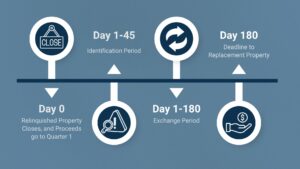
The exchange begins the day the relinquished property closes. This is Day 0. At closing, the proceeds must be transferred directly to the QI. Once the sale is complete, the investor cannot receive or control the funds at any point during the exchange. This is when the 45-day and 180-day clocks begin.
Step 2: Identify Replacement Properties (Days 1–45)
During the first 45 days, investors must identify one or more replacement properties. Evaluating potential options includes reviewing financial performance, property condition, tenant mix, and long-term stability.
Identification must follow one of three IRS-approved methods:
- Three-Property Rule: Identify up to three properties, regardless of value.
- 200 Percent Rule: Identify any number of properties, as long as their combined fair market value does not exceed 200 percent of the relinquished property’s value.
- 95 Percent Exception: Identify any number of properties of any value, but the investor must acquire at least 95 percent of the total value identified.
Backup properties are strongly recommended because identified properties cannot be changed after Day 45.
Step 3: Acquire Replacement Property (Through Day 180)
The investor must close on one or more identified properties by Day 180. During this time, financing must be arranged, due diligence completed, and all closing documentation prepared. Coordination between the QI, lender, attorneys, and brokers ensures that the exchange proceeds are handled correctly. When the buyer is ready to close, the QI transfers the funds directly into escrow. The taxpayer never receives the funds, which maintains compliance with 1031 rules.
Step 4: Finalize and Report
After the exchange is completed, the taxpayer must file IRS Form 8824 with their tax return for that year. Form 8824 summarizes the timelines, identifies the properties exchanged, and confirms compliance. This step also includes reporting any boot, which is any cash or non-like-kind property received during the exchange. Boot is taxable and may impact the overall tax deferral. For buyers who need to acquire before selling, a reverse exchange may be an option.
Example Timeline
Pitfalls, Risks and Tips
The most significant pitfall in a 1031 exchange is missing deadlines. If an investor fails to identify properties by Day 45 or fails to close by Day 180, the exchange becomes a taxable sale. There are no standard extensions for missed deadlines.
Other common risks include:
- Submitting identification incorrectly or without required detail
- Identifying too few properties or failing to name backups
- Waiting too long to begin due diligence
- Not coordinating closely with the QI
- Overlooking financing challenges that may delay closing
To stay on track, investors should build a timeline, maintain communication with all parties, and begin evaluating replacement properties early. Having a strong team, including brokers, tax advisors, and legal counsel, helps prevent avoidable mistakes.
Frequently Asked Questions
- How do you count the 45 days?
Every calendar day counts, beginning the day after the sale of the relinquished property and ending on Day 45. - How long must you hold a property to qualify?
There is no strict rule, but investors typically hold for one to two years to demonstrate investment intent. - Can you get extensions?
Extensions occur only under specific IRS disaster relief notices or qualifying situations. - What if the tax return is due before the 180-day deadline?
The exchange must be completed before the tax return due date unless an extension is filed.
Conclusion
A successful 1031 exchange depends on careful timing. The 45-day identification period and 180-day exchange period are fixed deadlines that shape the entire process. Except in rare cases involving IRS disaster relief, these timelines cannot be extended. Investors who plan early, coordinate with trusted professionals, and track deadlines reduce risk and support smoother transactions. Timing is as important as property selection when pursuing tax deferral under Section 1031.
For tailored support with strategy and execution, visit our 1031 Exchanges page or to speak with a Sands Investment Group Advisor directly.